mirror of
https://github.com/krahets/LeetCode-Book.git
synced 2026-01-12 00:19:02 +08:00

6.0 KiB
Executable File
6.0 KiB
Executable File
解题思路:
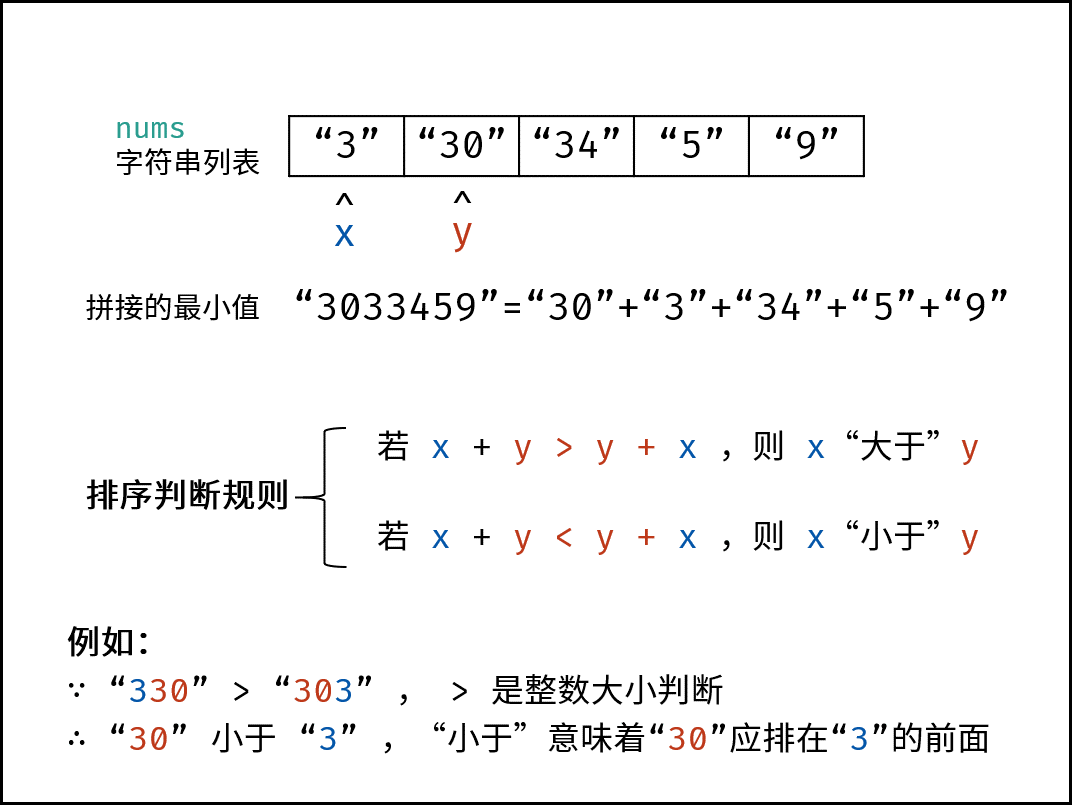
此题求拼接起来的最小数字,本质上是一个排序问题。设数组 password 中任意两数字的字符串为 x 和 y ,则规定 排序判断规则 为:
- 若拼接字符串
x + y > y + x,则x“大于”y; - 反之,若
x + y < y + x,则x“小于”y;
x“小于”y代表:排序完成后,数组中x应在y左边;“大于” 则反之。
根据以上规则,套用任何排序方法对 password 执行排序即可。
 {:align=center width=450}
算法流程:
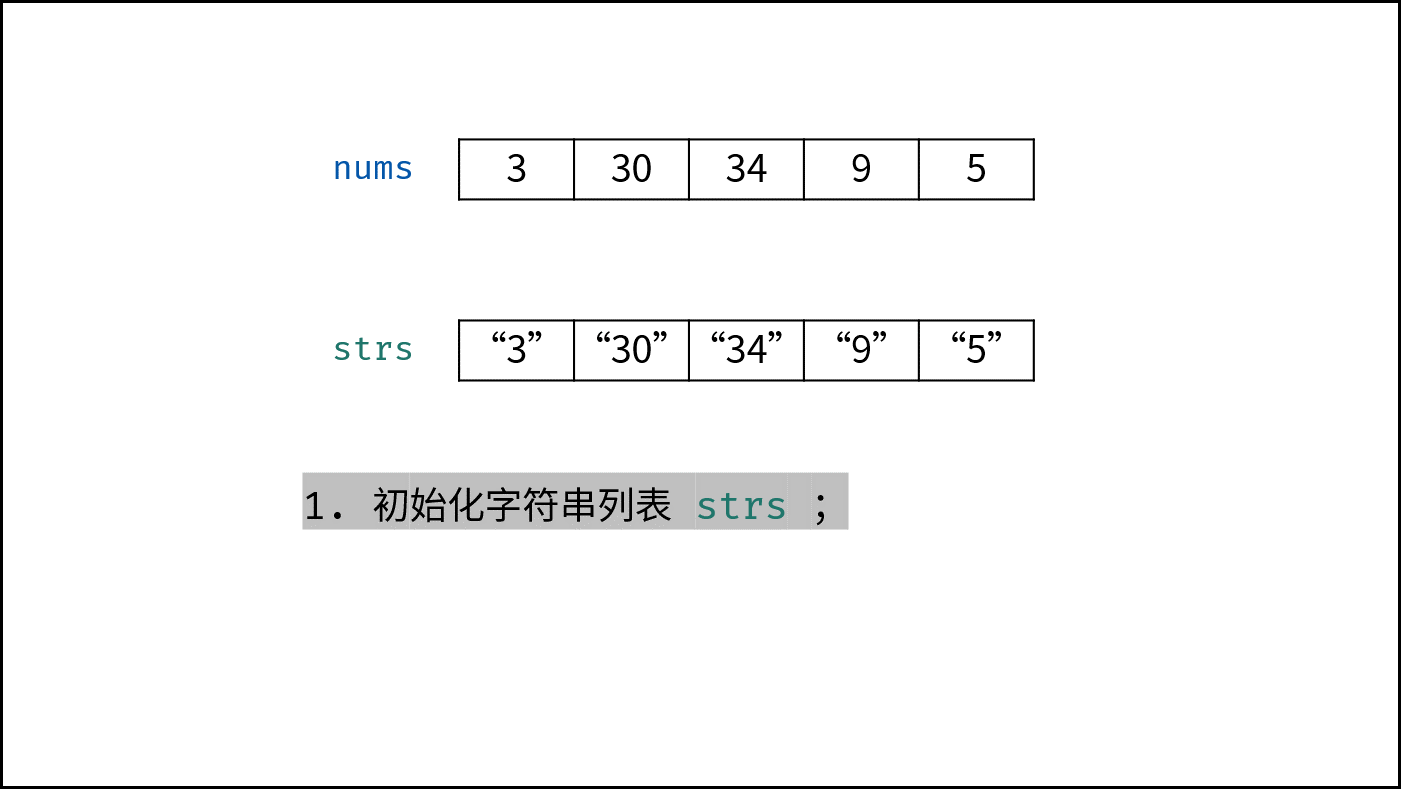
- 初始化: 字符串列表
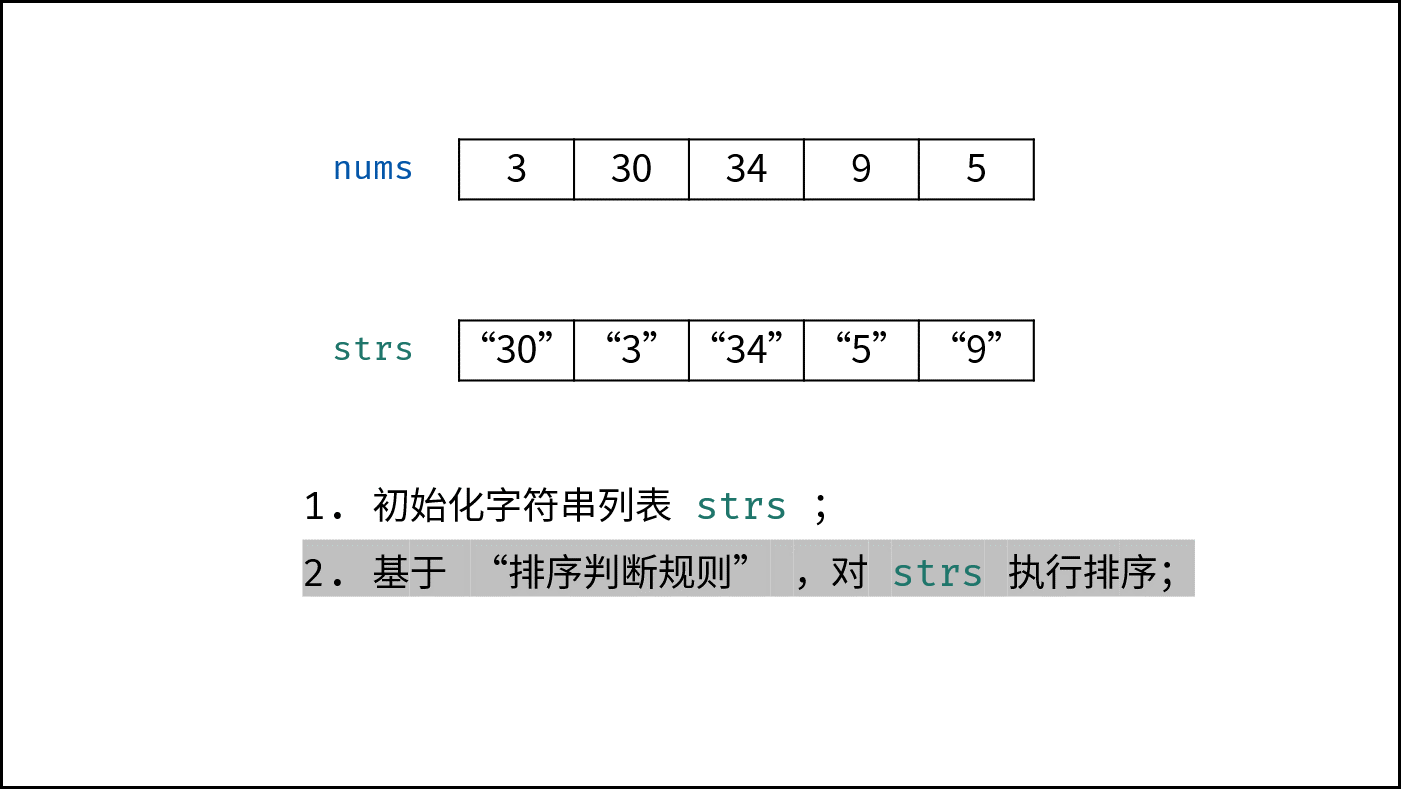
strs,保存各数字的字符串格式; - 列表排序: 应用以上 “排序判断规则” ,对
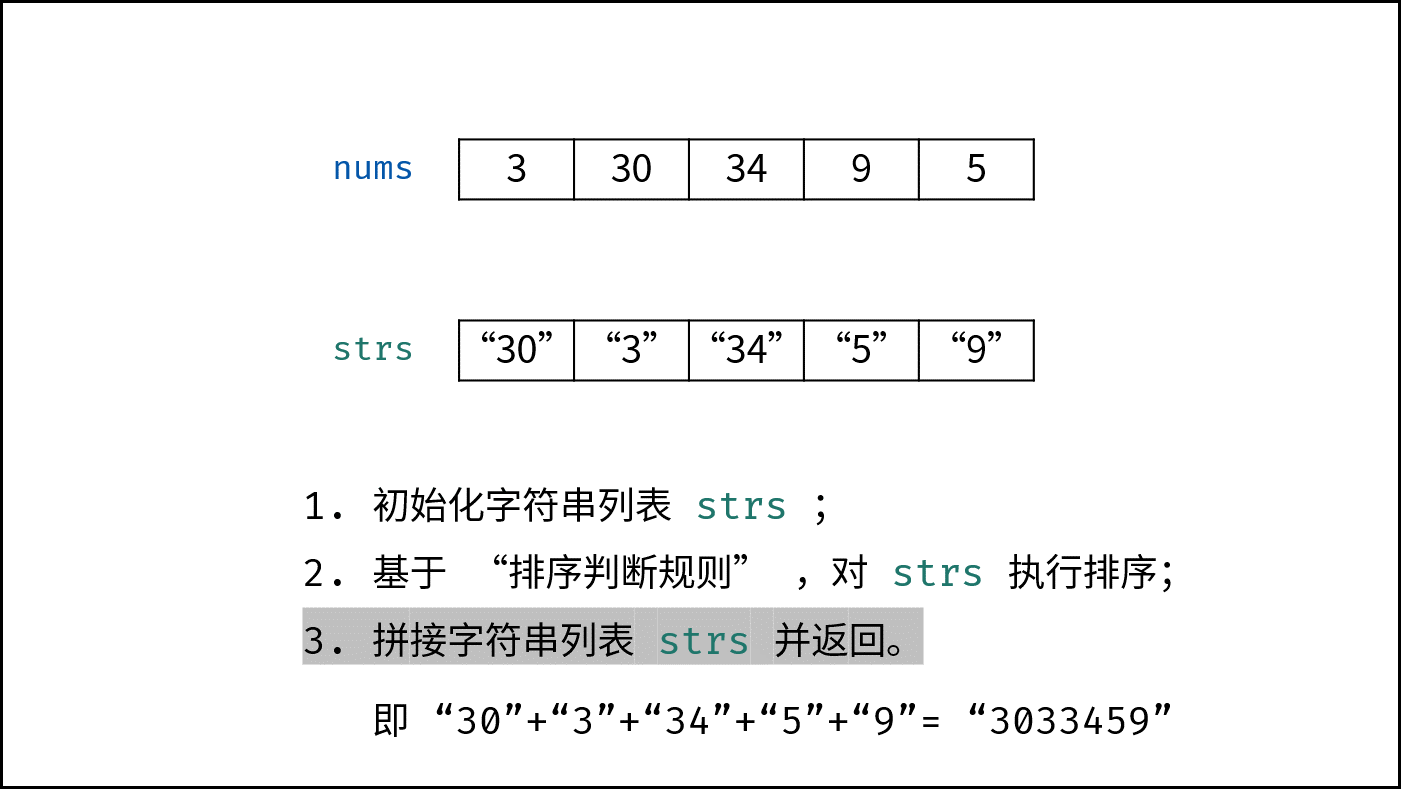
strs执行排序; - 返回值: 拼接
strs中的所有字符串,并返回。
下图中
nums对应本题的password。
< ,
, ,
, >
>
代码:
本文列举 快速排序 和 内置函数 两种排序方法,其他排序方法也可实现。
快速排序:
需修改快速排序函数中的排序判断规则。字符串大小(字典序)对比的实现方法:
- Python/C++ 中可直接用
<,>; - Java 中使用函数
A.compareTo(B);
class Solution:
    def crackPassword(self, password: List[int]) -> str:
        def quick_sort(l , r):
            if l >= r: return
            i, j = l, r
            while i < j:
                while strs[j] + strs[l] >= strs[l] + strs[j] and i < j: j -= 1
                while strs[i] + strs[l] <= strs[l] + strs[i] and i < j: i += 1
                strs[i], strs[j] = strs[j], strs[i]
            strs[i], strs[l] = strs[l], strs[i]
            quick_sort(l, i - 1)
            quick_sort(i + 1, r)

        strs = [str(num) for num in password]
        quick_sort(0, len(strs) - 1)
        return ''.join(strs)
class Solution {
    public String crackPassword(int[] password) {
        String[] strs = new String[password.length];
        for(int i = 0; i < password.length; i++)
            strs[i] = String.valueOf(password[i]);
        quickSort(strs, 0, strs.length - 1);
        StringBuilder res = new StringBuilder();
        for(String s : strs)
            res.append(s);
        return res.toString();
    }
    void quickSort(String[] strs, int l, int r) {
        if(l >= r) return;
        int i = l, j = r;
        String tmp = strs[i];
        while(i < j) {
            while((strs[j] + strs[l]).compareTo(strs[l] + strs[j]) >= 0 && i < j) j--;
            while((strs[i] + strs[l]).compareTo(strs[l] + strs[i]) <= 0 && i < j) i++;
            tmp = strs[i];
            strs[i] = strs[j];
            strs[j] = tmp;
        }
        strs[i] = strs[l];
        strs[l] = tmp;
        quickSort(strs, l, i - 1);
        quickSort(strs, i + 1, r);
    }
}
class Solution {
public:
    string crackPassword(vector<int>& password) {
        vector<string> strs;
        for(int i = 0; i < password.size(); i++)
            strs.push_back(to_string(password[i]));
        quickSort(strs, 0, strs.size() - 1);
        string res;
        for(string s : strs)
            res.append(s);
        return res;
    }
private:
    void quickSort(vector<string>& strs, int l, int r) {
        if(l >= r) return;
        int i = l, j = r;
        while(i < j) {
            while(strs[j] + strs[l] >= strs[l] + strs[j] && i < j) j--;
            while(strs[i] + strs[l] <= strs[l] + strs[i] && i < j) i++;
            swap(strs[i], strs[j]);
        }
        swap(strs[i], strs[l]);
        quickSort(strs, l, i - 1);
        quickSort(strs, i + 1, r);
    }
};
内置函数:
需定义排序规则:
- Python 定义在函数
sort_rule(x, y)中; - Java 定义为
(x, y) -> (x + y).compareTo(y + x); - C++ 定义为
(string& x, string& y){ return x + y < y + x; };
class Solution:
    def crackPassword(self, password: List[int]) -> str:
        def sort_rule(x, y):
            a, b = x + y, y + x
            if a > b: return 1
            elif a < b: return -1
            else: return 0

        strs = [str(num) for num in password]
        strs.sort(key = functools.cmp_to_key(sort_rule))
        return ''.join(strs)
class Solution {
    public String crackPassword(int[] password) {
        String[] strs = new String[password.length];
        for(int i = 0; i < password.length; i++)
            strs[i] = String.valueOf(password[i]);
        Arrays.sort(strs, (x, y) -> (x + y).compareTo(y + x));
        StringBuilder res = new StringBuilder();
        for(String s : strs)
            res.append(s);
        return res.toString();
    }
}
class Solution {
public:
    string crackPassword(vector<int>& password) {
        vector<string> strs;
        string res;
        for(int i = 0; i < password.size(); i++)
            strs.push_back(to_string(password[i]));
        sort(strs.begin(), strs.end(), [](string& x, string& y){ return x + y < y + x; });
        for(int i = 0; i < strs.size(); i++)
            res.append(strs[i]);
        return res;
    }
};
复杂度分析:
- 时间复杂度
O(N \log N):N为最终返回值的字符数量(strs列表的长度\leq N);使用快排或内置函数的平均时间复杂度为O(N \log N),最差为O(N^2)。 - 空间复杂度
O(N): 字符串列表strs占用线性大小的额外空间。