
4.7 KiB
Executable File
解题思路:
本题考察对位运算的灵活使用,即使用位运算实现加法。
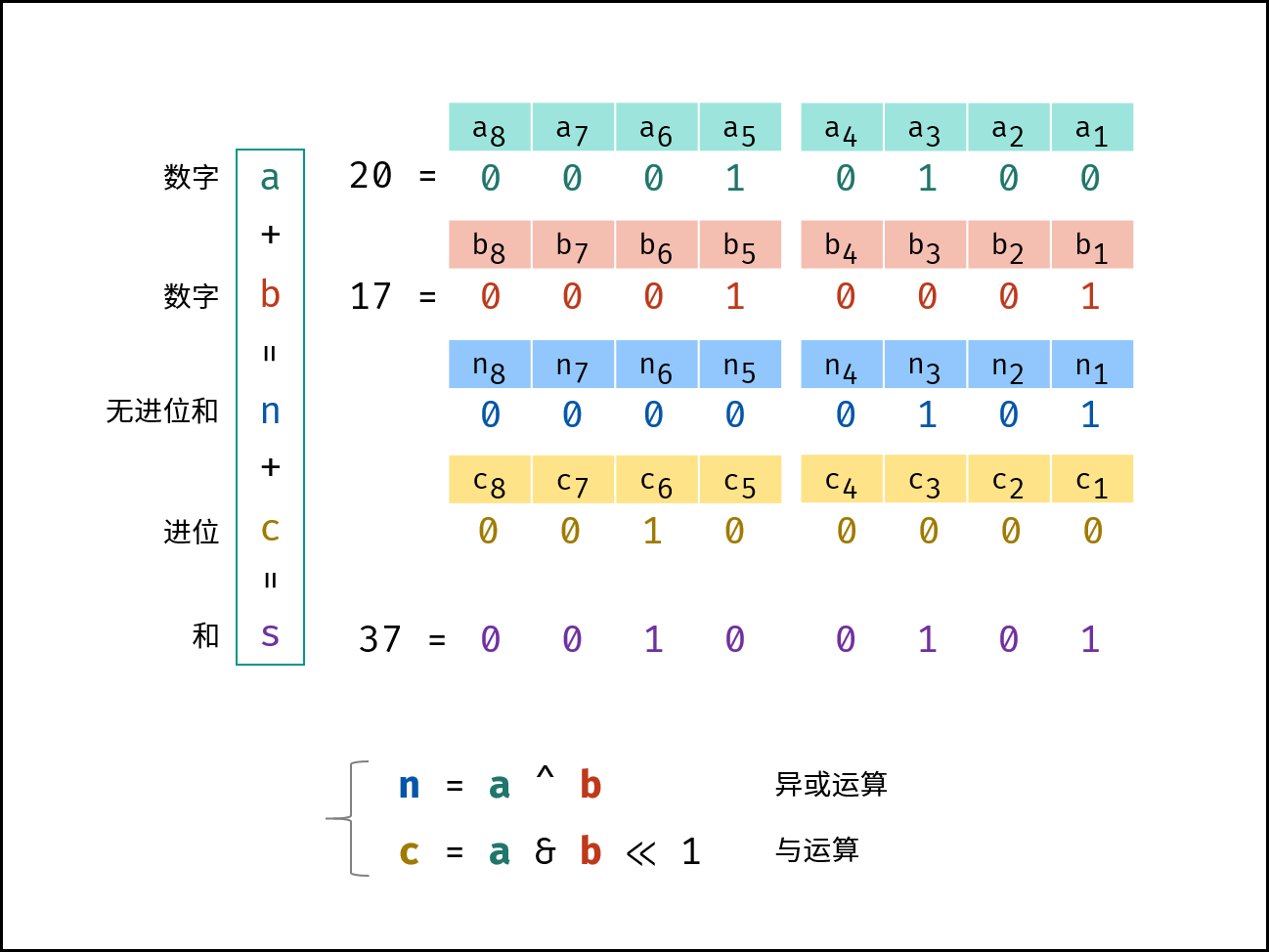
设两数字的二进制形式 dataA, dataB ,其求和 s = dataA + dataB ,dataA(i) 代表 dataA 的二进制第 i 位,则分为以下四种情况:
dataA(i) |
dataB(i) |
无进位和 n(i) |
进位 c(i+1) |
|---|---|---|---|
0 |
0 |
0 |
0 |
0 |
1 |
1 |
0 |
1 |
0 |
1 |
0 |
1 |
1 |
0 |
1 |
观察发现,无进位和 与 异或运算 规律相同,进位 和 与运算 规律相同(并需左移一位)。因此,无进位和 n 与进位 c 的计算公式如下;
\begin{cases}
n = dataA \oplus dataB & 非进位和:异或运算 \\
c = dataA \space \& \space dataB << 1 & 进位:与运算 + 左移一位
\end{cases}
(和 s )$=$(非进位和 n )$+$(进位 c )。即可将 s = dataA + dataB 转化为:
s = dataA + dataB \Rightarrow s = n + c
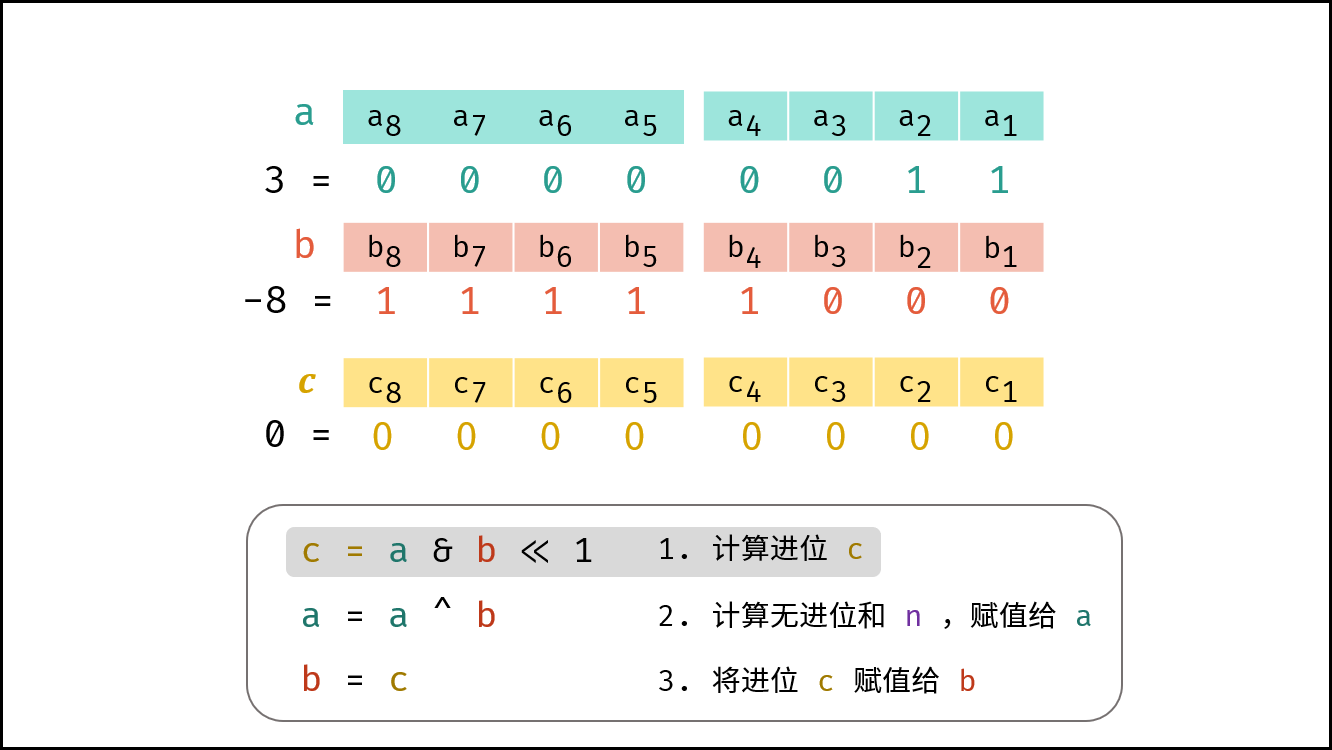
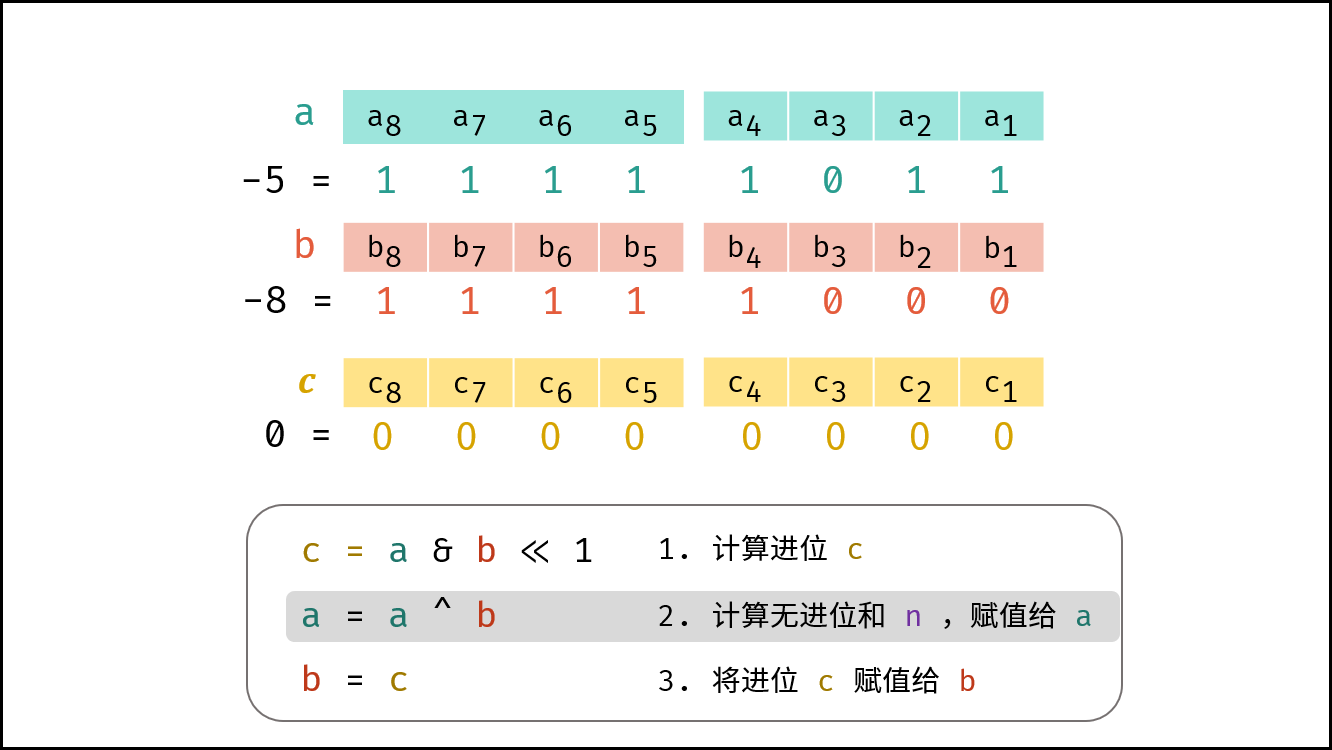
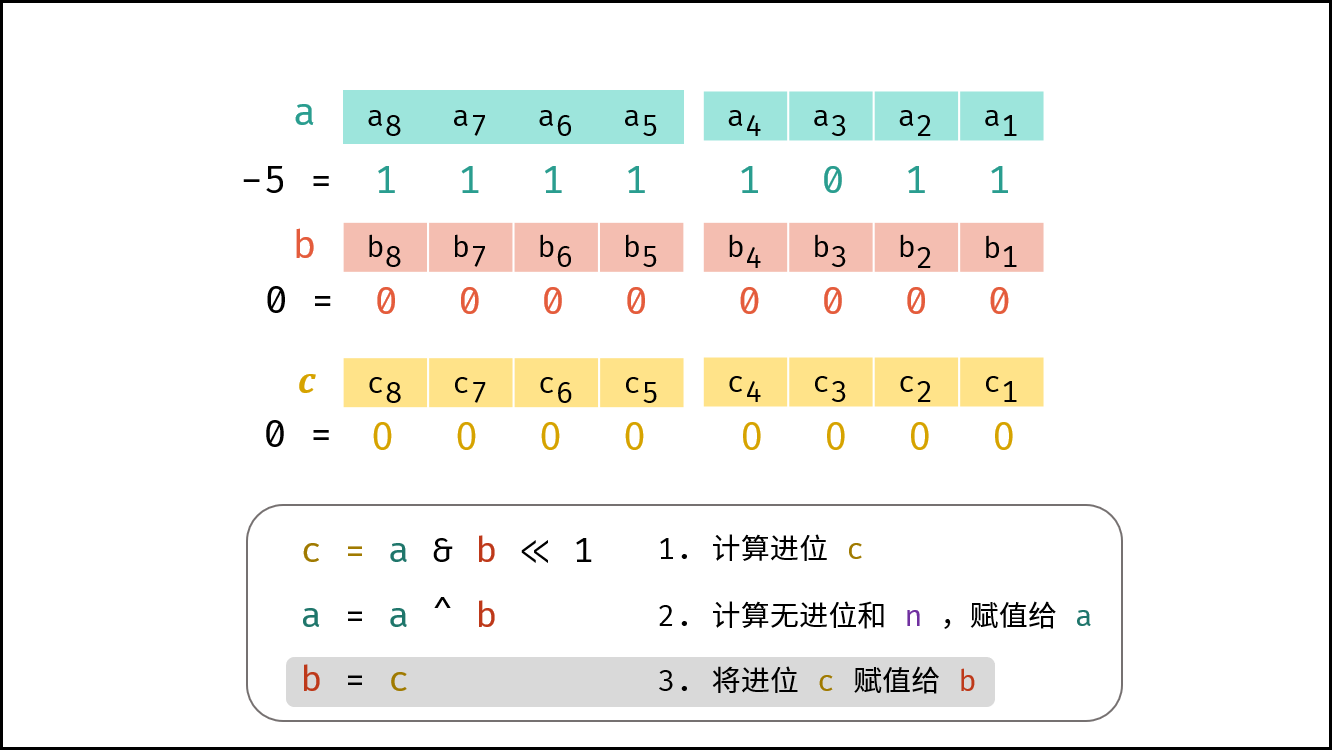
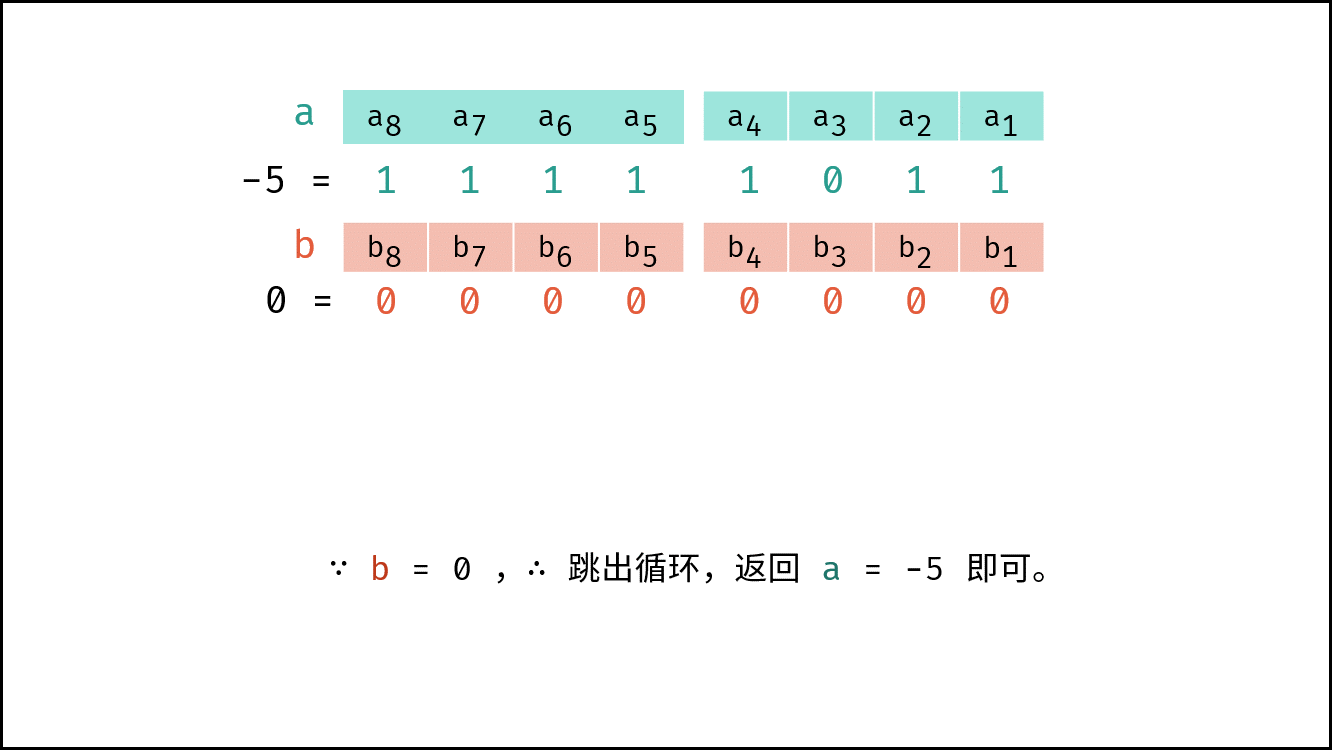
循环求 n 和 c ,直至进位 c = 0 ;此时 s = n ,返回 n 即可。
下图中的
a和b对应本题的dataA和dataB。
 {:align=center width=500}
Q : 若数字
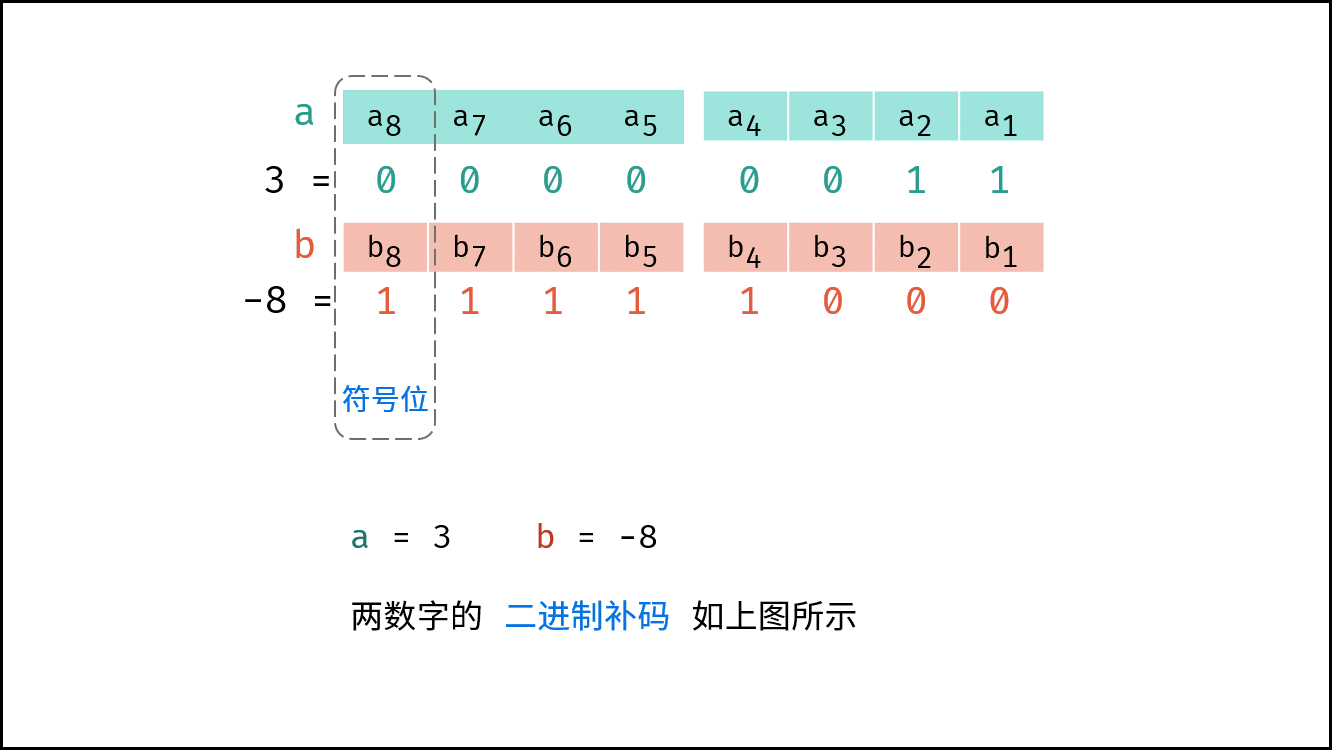
dataA和dataB中有负数,则变成了减法,如何处理? A : 在计算机系统中,数值一律用 补码 来表示和存储。补码的优势: 加法、减法可以统一处理(CPU只有加法器)。因此,以上方法 同时适用于正数和负数的加法 。
< ,
, ,
, ,
, ,
, >
>
代码:
class Solution {
    public int encryptionCalculate(int dataA, int dataB) {
        while(dataB != 0) { // 当进位为 0 时跳出
            int c = (dataA & dataB) << 1;  // c = 进位
            dataA ^= dataB; // dataA = 非进位和
            dataB = c; // dataB = 进位
        }
        return dataA;
    }
}
class Solution {
public:
    int encryptionCalculate(int dataA, int dataB) {
        while(dataB != 0)
        {
            int c = (unsigned int)(dataA & dataB) << 1;
            dataA ^= dataB;
            dataB = c;
        }
        return dataA;
    }
};
class Solution:
    def encryptionCalculate(self, dataA: int, dataB: int) -> int:
        x = 0xffffffff
        dataA, dataB = dataA & x, dataB & x
        while dataB != 0:
            dataA, dataB = (dataA ^ dataB), (dataA & dataB) << 1 & x
        return dataA if dataA <= 0x7fffffff else ~(dataA ^ x)
复杂度分析:
- 时间复杂度
O(1): 最差情况下(例如dataA =\text{0x7fffffff},dataB = 1时),需循环 32 次,使用O(1)时间;每轮中的常数次位操作使用O(1)时间。 - 空间复杂度
O(1): 使用常数大小的额外空间。
Python 负数的存储:
Python,Java, C++ 等语言中的数字都是以 补码 形式存储的。但 Python 没有 int , long 等不同长度变量,即在编程时无变量位数的概念。
获取负数的补码: 需要将数字与十六进制数 0xffffffff 相与。可理解为舍去此数字 32 位以上的数字(将 32 位以上都变为 0 ),从无限长度变为一个 32 位整数。
返回前数字还原: 若补码 dataA 为负数( 0x7fffffff 是最大的正数的补码 ),需执行 ~(dataA ^ x) 操作,将补码还原至 Python 的存储格式。dataA ^ x 运算将 1 至 32 位按位取反;~ 运算是将整个数字取反;因此,~(dataA ^ x) 是将 32 位以上的位取反,1 至 32 位不变。
print(hex(1)) # = 0x1 补码
print(hex(-1)) # = -0x1 负号 + 原码 ( Python 特色,Java 会直接输出补码)

print(hex(1 & 0xffffffff)) # = 0x1 正数补码
print(hex(-1 & 0xffffffff)) # = 0xffffffff 负数补码

print(-1 & 0xffffffff) # = 4294967295 ( Python 将其认为正数)